
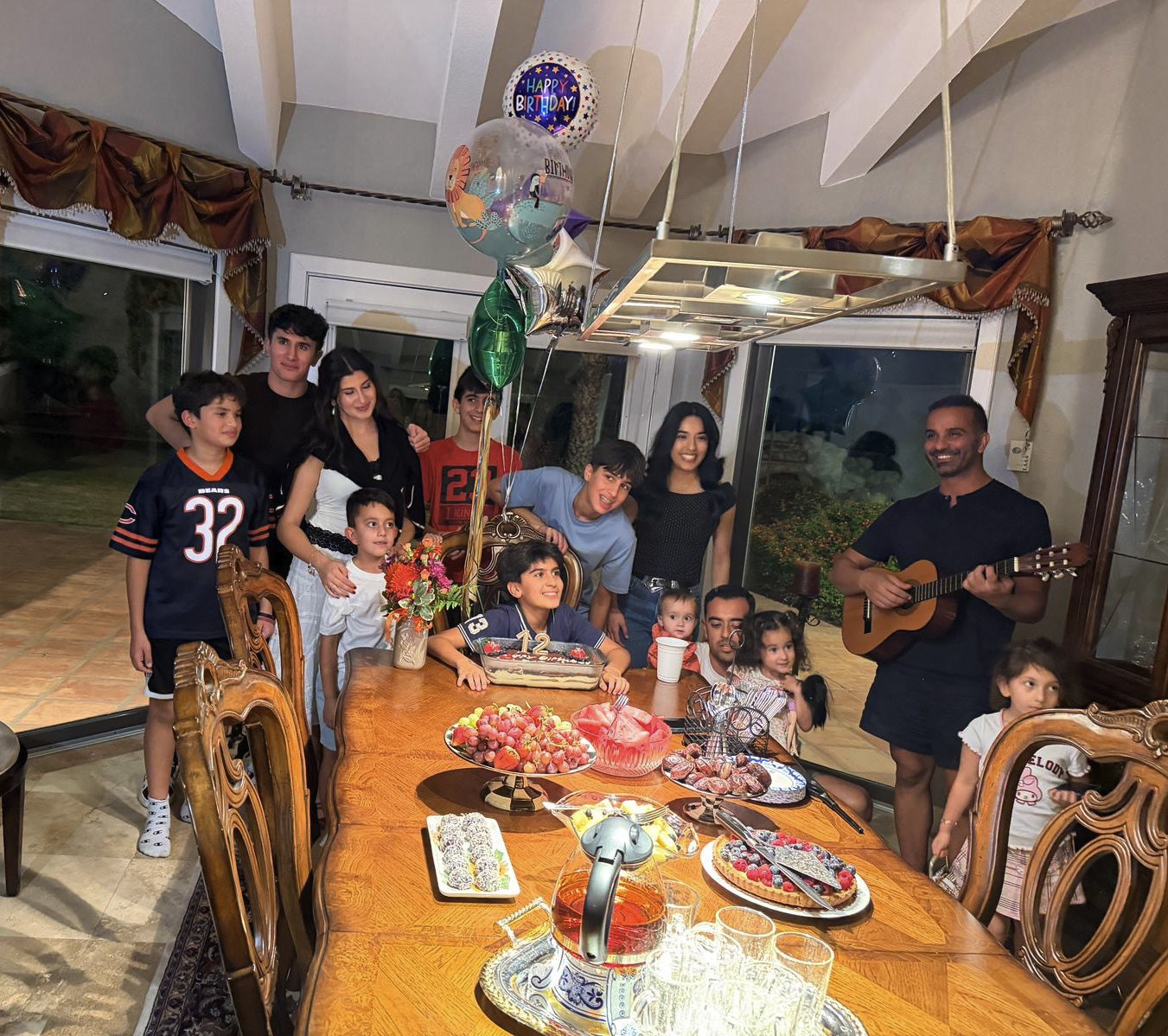
Sunday Persian family gathering. Conversations from all directions, plates clattering, someone getting advice on home renovations. I escape to see my two cousins: Aria and Ryan.
Aria is working on a problem. The equation sits there on the page; harmless until you had to solve it.
"What's the best way to solve for
I glanced at it. "Quadratic formula."
Ryan, sitting next to us, perks up. "What's that?"
Aria rattled it off without hesitation: "x equals negative b plus or minus the square root of b squared minus four a c, all over two a."
The formula's memorized. Filed away. Ready for deployment.
Ryan's face does that thing when he's about to see a magic trick. "But what is it?"
Good question.
The Thing About Perspectives
We're told to look at problems from different angles. Fair advice. But most of us stay in the same medium while we turn our heads. We read another book. Watch another lecture. Ask another teacher to explain it the same way, just slower.
Sometimes the medium itself is the problem.
Math suffers from this especially. You can spend years inside the algebraic realm—manipulating symbols, following rules, arriving at answers (sometimes)—and never once step outside to see what the landscape looks like. There's a geometric world parallel to the algebraic one, and most students never get introduced.
Consider this: You can understand that
Or take calculus. The derivative is the slope of a tangent line. It's also the rate of change. It's also the limit of a difference quotient. Three descriptions. Same thing. Each one a different doorway into the same room.
The more doorways you have, the more likely you are to find your way in.
How We Know a Table
I keep thinking about my senses. A philosopher's pastime.
I know there's a table in front of me because I see it. Dark wood, four legs, textured surface. I also know it's there because I can touch it—solid, cool, smooth in some places and rough in others. If I wanted to be thorough, I could smell it. Old varnish, maybe. A hint of mushroom coffee from this morning.
All these experiences feel completely different. Vision isn't touch. Touch isn't smell. But they all point to the same object. Each sense gives me a piece of the truth, and together they form something more complete than any single one could manage.
There's a philosopher who obsessed over exactly this problem. Maurice Merleau-Ponty noticed something strange: when you look at a cube, you only see three faces. When you touch it, you feel six. These experiences share almost nothing phenomenologically. What it feels like to see is wildly different from what it feels like to touch.
And yet you know, without thinking, that you're encountering the same cube.
He called this synaesthetic perception[1]. Not synesthesia in the traditional sense, but something more fundamental: your senses are already coordinated, already pointing at the same world. The cube isn't a visual cube plus a tactile cube that your brain stitches together. It's one cube that reveals itself to vision in one way and to touch in another.
The whole is richer than any single sense can capture.
Math works the same way.
When you grasp an idea algebraically and geometrically, it's not redundant. It's stereo. You're hearing the same music through two speakers, and suddenly there's depth.
Food Interrupts Everything
That Sunday afternoon, I had both cousins leaning in. They wanted to know where the quadratic formula came from.
"Okay," I said. "Let me show you something. You know how to solve for
Both nodded.
"What about
They squinted.
"That's where completing the square comes in. It's actually—"
"DINNER'S READY!"
And just like that, the conversation died. We filed into the dining room. The moment evaporated.
But the question stuck with me.
So I made a video. Two videos, actually. One for each doorway.
The First Door: Completing the Square
Here's what most students learn:
To solve
, you take half of the coefficient in front of (that's ), square it (that's ), and add it to both sides. Now you've got . The left side factors into . Take the square root of both sides. Solve for .
It works. You get the right answer.
But why does it work?
Most explanations stop at the procedure. Do this, then this, then this. Practice until perfected. Like following a recipe you don't understand. The food comes out fine, but you're not a cook yet.
Here's the thing: completing the square isn't just an algebraic trick. It's a geometric reality.
Watch this:
You start with a square of side
Suddenly the formula isn't arbitrary. It's visible.
Two Perspectives, One Truth
What struck me about explaining this to Ryan and Aria—or trying to before dinner interrupted—was how different the two approaches felt.
Algebraically, completing the square is manipulation. You're following rules, moving symbols, getting the answer. It's precise. It's reliable. But it feels like moving through fog.
Geometrically? You're building something. The pieces fit together because they have to. The method isn't imposed from outside; it emerges from the shapes themselves.
Neither perspective is superior. But together? Together they're something else entirely.
If I could touch completing the square, I imagine it would feel like fitting puzzle pieces together—smooth edges clicking into place. If I could smell it, maybe it would smell like cut wood, fresh and exact.
Which brings us to the second doorway.
The Second Door: Where Formulas Come From
Now we get to the thing Aria had memorized with ease.
The quadratic formula,
But few are taught that it's just completing the square in disguise.
Start with the general quadratic:
That's it. That's the secret.
The quadratic formula isn't some separate entity handed down from mathematical heaven. It's what happens when you complete the square on the most general possible quadratic equation and simplify.
Once you see that, you can't unsee it.
This second video takes the geometric approach to completing the square and pushes it one step further. Now we're working with variables instead of numbers, but the shapes still fit together. The formula emerges—not as something to memorize, but as something inevitable.
The Door You Didn't Know Was There
Here's what I wish someone had told me when I was Ryan's age, or Aria's age, or any age before I figured it out myself:
The medium matters.
You can read about music, but listening to it is different. You can read about the ocean, but standing in it is different. Or consider chess: playing a game immerses you in tactics and pressure, but studying the notation afterwards reveals patterns you missed in the moment. Different modes, same game, deeper understanding.
You can algebraically manipulate
Math education tends to stay in one lane. Algebra textbooks do algebra. Geometry textbooks do geometry. The bridges between them are footnotes, if they exist at all.
But the bridges are where the interesting stuff happens.
Understanding is what happens when you approach the same idea from multiple directions and realize they all lead to the same place. That's when the lightbulb flickers on. That's when math stops being abstract and becomes real.
A Note on Seeking Sideways
I made those videos for Aria and Ryan, but also for myself. Teaching forces clarity.
We spend a lot of time looking at things straight-on. Same angle, same medium, same approach. But sometimes the clearest view is the one from the side, or from above, or from some direction you didn't know existed.
Math gives us tools for this. Algebra and geometry are just two of them. There are others: calculus, topology, number theory, group theory, category theory. Theory, theory, theory. Mathematicians get lazy with naming. Each with its own language and logic. Each one a different sense, perceiving the same underlying truth.
You don't hear much about this in AI or machine learning, but it's fundamental. Multi-modal systems are starting to understand: an image and its text description point to the same thing, just like vision and touch point to the same table. Different inputs, same reality.
If you're stuck on something, try switching mediums. Draw it. Build it. Sing it if you have to. The answer might not change, but your relationship to it will.
And sometimes that's all you need.
Footnotes
[1] Merleau-Ponty's Phenomenology of Perception explores how we experience the world through our bodies before we analyze that experience intellectually. If you're curious about how different modes of perception converge on the same reality, it's worth the read. Fair warning: French phenomenology is dense.↵